Now Reading: Cursor AI vs. GitHub Copilot: Which AI Coding Tool
-
01
Cursor AI vs. GitHub Copilot: Which AI Coding Tool
Cursor AI vs. GitHub Copilot: Which AI Coding Tool

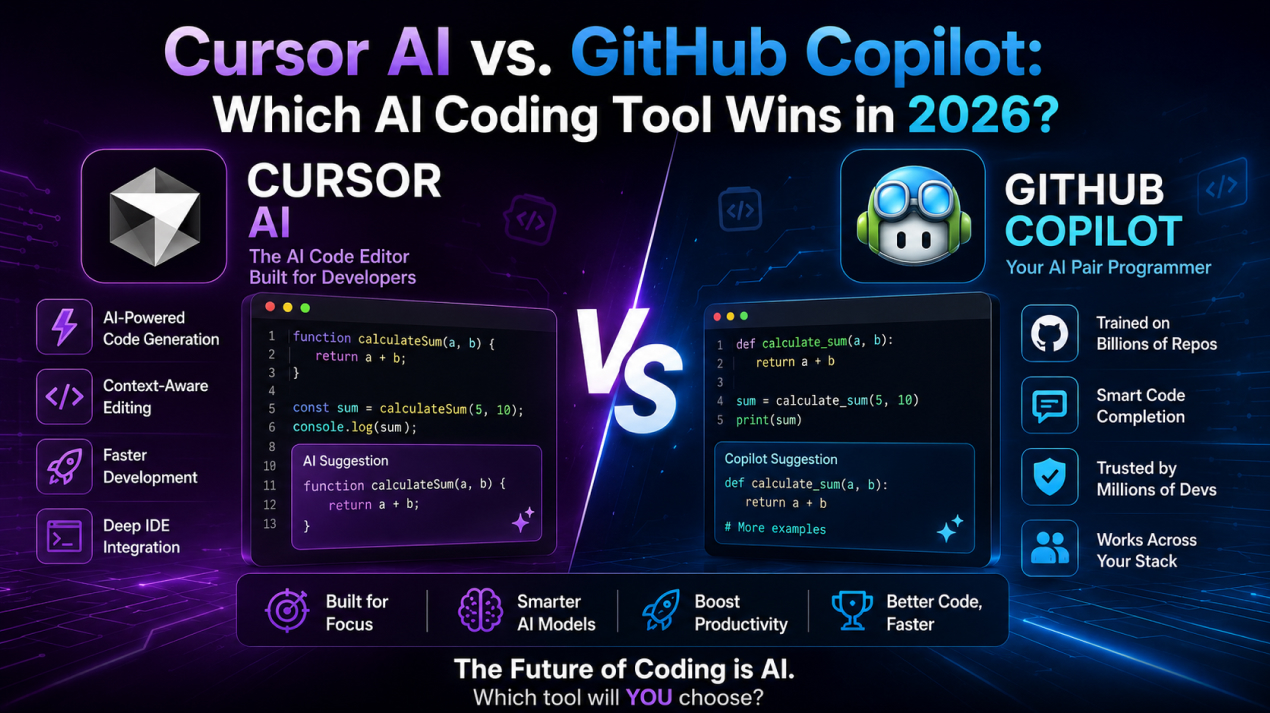
In 2026, every developer agrees that AI coding tools are changing how code is written, edited, and managed. And for the very reason, two popular options that are leading this shift are Cursor AI and GitHub Copilot.
Both tools aim to improve productivity, reduce manual work, and help developers build faster. However, they work in different ways, and understanding them is important. That’s why, in this guide, I’ll compare Cursor AI and GitHub Copilot in detail, covering their features, benefits, and real-world use. This will help you decide which tool is the better fit for you.
What is Cursor AI
In simple terms, Cursor AI is an AI-powered code editor that is designed to help you write, edit, and manage entire codebases more efficiently. Unlike traditional coding assistants, Cursor works as a full editor with built-in AI capabilities. It allows you to edit multiple files, refactor code, and generate complete features using simple instructions.

Cursor AI stands out for its deep understanding of codebases. It can read your project structure and provide context-aware changes across files. One of its key features is Composer, which lets you make large edits or quickly add new functionality.
Instead of writing code line by line, you can describe what you want, and Cursor handles the rest.
What is GitHub Copilot
GitHub Copilot is an AI coding assistant that is developed by GitHub in partnership with OpenAI. It works inside popular code editors like Visual Studio Code and helps you write code by suggesting lines, functions, and solutions in real time.

Copilot is designed to improve coding speed and reduce repetitive tasks. It reads your current file and context to generate useful suggestions as you type. You can also use comments to describe what you want, and Copilot turns those ideas into working code.
In 2026, GitHub Copilot is widely used by developers for its ease of use, accuracy, and strong integration with existing workflows.
Top Features & Benefits of Cursor AI
Full Codebase Understanding
Cursor AI can understand your entire project, not just a single file. This allows it to make smarter suggestions and edits across multiple files. You can ask Cursor to update functions, fix bugs, or refactor code across the project.
This saves time and reduces manual effort. It is especially useful for large codebases where managing changes manually can be difficult. With this feature, Cursor acts like a smart assistant that knows your project inside out and helps you work faster.
Composer for Large Edits
Composer is one of Cursor AI’s most powerful features. It allows you to describe changes in plain language and apply them across the project. Instead of editing code manually, you can request updates, and Cursor handles the process.
This makes it easy to build new features and modify existing ones quickly. Composer improves efficiency and reduces repetitive work. It is ideal for those who want to speed up development without compromising control over their code.
AI-Powered Code Editing
Cursor AI offers advanced AI-powered editing capabilities. As a developer, you can rewrite, optimize, and refactor code with simple commands. The tool ensures that changes are consistent and aligned with the project structure.
This helps maintain clean and organized code. It also reduces errors and improves readability. With AI-powered editing, you can focus more on building features and less on fixing or rewriting code manually.
Built-In AI Chat
Cursor includes an integrated AI chat feature that can help you understand code, debug issues, and generate solutions. Instead of searching online, you can ask questions directly within the editor.
The chat provides clear explanations and useful suggestions. This improves learning and problem-solving speed. It is especially helpful for beginners and developers who are working on complex tasks.
Faster Development Workflow
Cursor AI is designed to speed up the entire development process. From writing code to editing and testing, it reduces the time needed for each step. You can complete tasks faster and handle complex projects more efficiently.
This leads to greater productivity and faster project delivery. In 2026, Cursor is a strong choice for developers who want an all-in-one AI coding solution that improves workflow and performance.
Top Features & Benefits of GitHub Copilot
Real-Time Code Suggestions
GitHub Copilot provides real-time code suggestions as you type. It predicts what you want to write and completes lines or functions instantly. This reduces typing effort and speeds up coding. The suggestions are context-based, making them relevant and useful.
You can accept or modify them easily. This feature is ideal for handling repetitive tasks and improving efficiency. It helps you stay focused and maintain a smooth workflow without interruptions.
Context-Aware Assistance
Copilot understands the context of your code, including comments and structure. This allows it to generate accurate and meaningful suggestions. You can write simple instructions, and Copilot turns them into working code.
This reduces the need for manual coding and searching for solutions. Context awareness also makes the tool more reliable and effective. It acts like a smart assistant that helps you think and code simultaneously.
Multi-Language Support
GitHub Copilot supports a wide range of programming languages. Whether you are working on web development, backend systems, or software applications, it adapts easily. This flexibility allows developers to switch between projects without losing productivity.
It also helps maintain consistency across different technologies. Multi-language support makes Copilot a practical tool for developers who are working in diverse environments and handling multiple coding tasks.
Seamless IDE Integration
Copilot integrates smoothly with popular code editors like Visual Studio Code. You can use it without changing their workflow. The setup is simple, and the tool runs in the background, automatically offering suggestions.
This seamless experience saves time and improves usability. As a developer, you can focus on coding without worrying about switching tools or managing complex setups.
Boosts Developer Productivity
GitHub Copilot helps you complete tasks faster by reducing repetitive work and providing instant solutions. It improves efficiency and allows you to focus on problem-solving.
Teams can deliver projects more quickly and maintain better code quality. By automating routine tasks, Copilot makes development smoother and more productive.
Pros and Cons of Cursor AI
Pros
Deep Codebase Understanding: Cursor AI understands your entire project structure, allowing it to make accurate edits across files. This helps you manage large codebases efficiently and reduces the need for repetitive manual updates.
Powerful Composer Feature: The Composer feature allows you to describe changes in plain language and apply them instantly. It simplifies complex edits and speeds up development, making feature creation and refactoring much easier and faster.
All-in-One Code Editor: Cursor AI works as a complete code editor with built-in AI. Because of that, you do not need separate tools, which keeps everything in one place and improves workflow efficiency during development tasks.
Advanced Code Refactoring: It enables you to quickly rewrite and optimize code. This improves code quality, reduces errors, and helps maintain a clean structure without spending too much time on manual editing or corrections.
Built-In AI Chat Support: Cursor includes AI chat for debugging, explanations, and code generation. This reduces the need to search online and helps you solve problems faster, directly inside the editor environment.
Cons
Learning Curve for New Users: Beginners may take some time to understand Cursor AI. Its advanced features require practice, and new users may feel overwhelmed when using full codebase editing tools for the first time.
Limited Ecosystem Integration: Compared to other tools, Cursor has fewer integrations with external platforms. This can be a limitation for developers who rely on a wide ecosystem of tools and services in daily workflows.
Performance on Large Projects: While powerful, Cursor can sometimes slow down when handling very large projects. This may affect performance and cause delays when applying changes across multiple files or complex codebases.
Not Fully Free: Cursor AI is not entirely free; some features require payment. This can be a drawback for beginners or freelancers who are looking for a fully free AI coding assistant solution.
Still Evolving Platform: Cursor AI is relatively new compared to other tools. Some features are still improving, and occasional bugs or limitations may affect the experience for developers working on critical projects.
Pros and Cons of GitHub Copilot
Pros
Fast Real-Time Suggestions: GitHub Copilot provides instant code suggestions as you type. This helps you write code faster, reduces manual effort, and keeps the workflow smooth and uninterrupted during development.
Strong Context Awareness: Copilot understands your code and comments to generate accurate suggestions. This improves the quality of output and helps you create better solutions without constantly searching for references or examples.
Wide Language Support: It supports multiple programming languages, making it suitable for different types of projects. As a developer, you can switch between technologies easily without losing productivity or needing additional tools.
Seamless IDE Integration: Copilot integrates directly into popular editors like VS Code. As a developer, you can use it without changing your workflow, making it simple, efficient, and easy to adopt for daily coding tasks.
Improves Productivity: By automating repetitive coding tasks, Copilot helps you complete work faster. It allows you to focus on logic and problem-solving, improving overall efficiency and project delivery speed.
Cons
Requires Paid Subscription: GitHub Copilot is a paid tool for most users. This may not be ideal for beginners or developers who are looking for a free solution, especially when working on personal or small projects.
Occasional Incorrect Suggestions: Copilot sometimes generates inaccurate or incomplete code. That’s why, as a developer, you must review and test suggestions carefully, as relying fully on AI can lead to errors in the final output.
Limited Full Project Editing: Unlike Cursor, Copilot focuses on line-by-line suggestions. It does not handle large-scale edits across multiple files, which can limit its usefulness for complex project changes.
Internet Dependency: Copilot requires a stable internet connection to work properly. Without it, it becomes less effective, which can be inconvenient in offline or low-connectivity environments.
Privacy Concerns: Some developers worry about sharing code with AI tools. Copilot processes code inputs, which may raise concerns for teams working on sensitive or confidential projects.
Cursor AI vs GitHub Copilot: Which is Better?
Choosing between Cursor AI and GitHub Copilot depends on how you work as a developer. Cursor AI is better for handling large projects and making full codebase changes. Its Composer feature and deep understanding make it ideal for developers who want control over entire systems, not just single files.
GitHub Copilot, on the other hand, is perfect for everyday coding tasks. It provides fast suggestions, smooth integration, and an easy learning curve. Developers who want quick help while writing code will find Copilot more convenient.
In short, if you need advanced editing and project-level control, Cursor AI is the better choice. If you want speed, simplicity, and reliable suggestions, GitHub Copilot is more practical.
FAQ’s
- Is Cursor AI better than GitHub Copilot?
Cursor AI is better for large projects and full code editing, while GitHub Copilot is better for quick suggestions and daily coding tasks.
- Can beginners use Cursor AI easily?
Beginners can use Cursor AI, but it may take time to learn.
- Is GitHub Copilot faster than Cursor AI?
GitHub Copilot is faster for real-time suggestions, while Cursor AI focuses more on deep editing and handling complex changes across projects.
- Do both tools support multiple programming languages?
Yes, both Cursor AI and GitHub Copilot support a wide range of programming languages, making them suitable for different development tasks.